Playground Climbers – Steel & Motion Systems
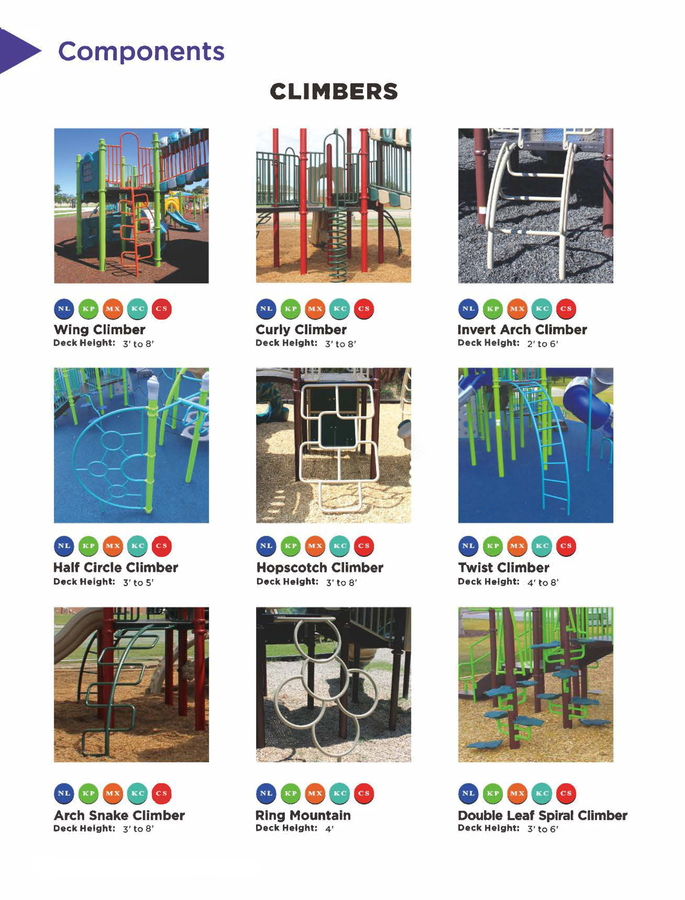

Steel climbers designed for dynamic movement, upper body engagement, and multi-directional access. These components emphasize flow, challenge, and continuous play across a range of deck heights.
Vertical and Curved Climbers
Wing Climber
Angled bar system providing multiple grip points for varied ascent paths.
Deck Height: 3' to 8'
Curly Climber
Spiral-style climber encouraging continuous upward movement and coordination.
Deck Height: 3' to 8'
Invert Arch Climber
Overhead and angled climbing path supporting upper body strength and transition play.
Deck Height: 2' to 6'
Rotational and Flow Climbers
Half Circle Climber
Curved climbing path allowing lateral and vertical movement.
Deck Height: 3' to 5'
Hopscotch Climber
Structured stepping pattern promoting coordination and sequencing skills.
Deck Height: 3' to 8'
Twist Climber
Rotating vertical path creating a challenging ascent with changing body positions.
Deck Height: 4' to 8'
Transitional and Themed Climbers
Arch Snake Climber
Wave-like climbing structure supporting continuous motion between entry and exit points.
Deck Height: 3' to 8'
Ring Mountain
Circular ring configuration encouraging creative climbing routes and group interaction.
Deck Height: 4'
Double Leaf Spiral Climber
Dual-path spiral climber providing multiple access routes and increased capacity.
Deck Height: 3' to 6'
Key Benefits
Promotes upper body strength, balance, and coordination
Encourages non-linear play and multiple climbing paths
Supports high user throughput with continuous movement designs
Durable steel construction for long-term performance
Best Applications
Access and transition points on larger play structures
Stand-alone climbing features in open play areas
High-traffic parks and school environments
Layouts requiring movement flow between elements
Planning Considerations
Match climber complexity to intended age group
Ensure clear entry and exit points to maintain user flow
Confirm fall height and surfacing compliance
Use dynamic climbers to complement static access components
- File
- comp6.jpg
- Albums